

Retro chat history and informal learning
At the height of the early-2000s panic about chat rooms, a quieter story was unfolding in a London cybercafe: children were teaching each other how virtual worlds worked.
Researchers Rebekah Willett and Julian Sefton-Green looked past the tabloid fear and found peer mentoring, language invention, identity play and practical digital skills. Basically, the kids were running a tiny classroom with avatars, slang and furniture. Obviously.
2001-02
London study period
10-13
Participant age range
4
Learning channels
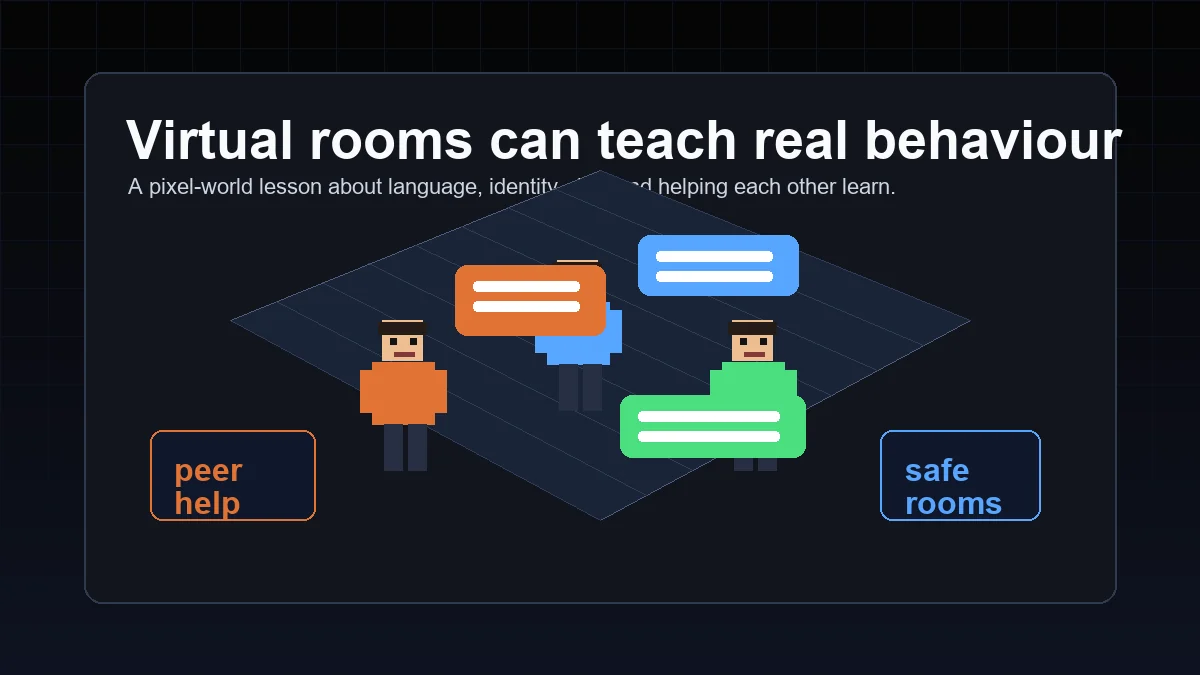
A virtual room can quietly teach people how to talk, behave, copy, experiment and belong.
The study
The research behind the Habbo Hotel learning study
The research was carried out in London between 2001 and 2002 as part of the Shared Spaces: Informal Learning of Digital Cultures project. The team studied 10 to 13-year-old girls using HabboHotel.com, a popular virtual world built around avatars, decorated rooms and social interaction.
Methods included direct observation, audio-screen recordings and short interviews in a supervised cybercafe setting provided by WAC Performing Arts and Media College.
The question was practical: how do young people learn digital skills together when nobody is standing at the front of the room with a worksheet and a laminated expression of despair?
The study matters because it captured online learning before social media norms had fully hardened. Children were discovering shortcuts, social rules and platform habits while those practices were still being invented.
Fair limits
Useful research, but not a magic universal claim
The study had limits. It focused on girls in a single supervised London setting, so it should not be stretched into a claim about every child, every country or every unsupervised online space.
That does not make the findings weak. It just means they should be read properly. The value is in the detailed observation of how children learned through peers, interfaces and shared culture.
Peer
Children copied, corrected and coached each other.
Design
Buttons, prompts and visible actions helped teach behaviour.
Culture
Slang, status and room etiquette became part of learning.
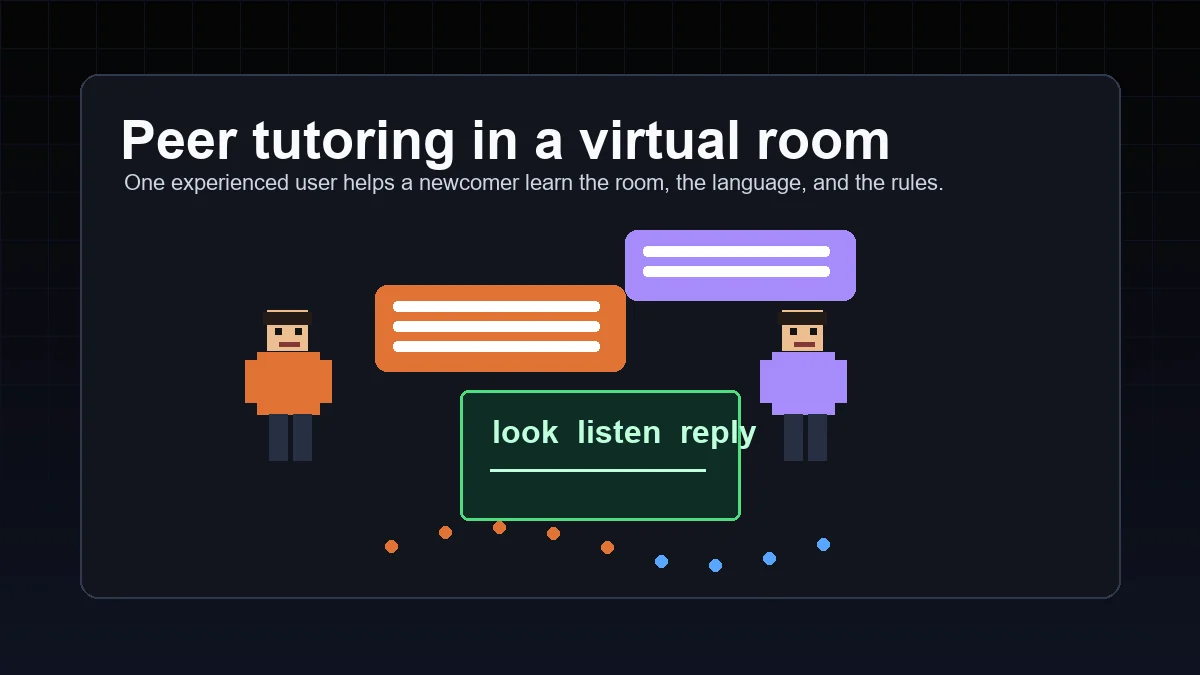
Peer tutoring was not formal, but it was immediate, practical and socially useful.
The chatroom as a classroom
Children learned by watching, copying, trying and reading the room
Watching peers move through the space and copying successful behaviour.
Following other users into popular rooms and seeing which actions got attention.
Testing commands, furniture and chat features to see what happened.
Using interface cues such as friend buttons, room labels and message prompts as quiet teaching tools.
The software taught part of the lesson. Other users taught the rest. Somewhere in the middle, digital literacy happened. That makes a useful contrast with our piece on how chatting changed deep reading and attention.
Helena and Natalie
Peer tutoring worked because it was right there in the moment
One of the clearest examples in the research was the relationship between two participants the study calls Helena and Natalie. Helena was a more confident user and stepped into a teacher-like role without formal authority.
She showed Natalie how to use the shout command, spot virtual jobs, avoid risky exchanges, and move between rooms more confidently. It was not a lesson plan. It was one user saying, in effect, “try this, it works”.
What Helena taught
How to make messages more visible.
How virtual jobs and status signals worked.
How to avoid scams, fake identities and weird pressure.
Why it mattered
The help was immediate.
The advice was in plain language.
Social norms came bundled with technical tips.
Language and identity
Chat play was not decoration. It was the lesson.
The study describes language development, identity experimentation and managed risk-taking as overlapping forms of learning. Children used shorthand, phonetic spellings and emoticons because speed mattered, but those choices also signalled belonging.
Avatars, outfits, skin tone and room design let users test presentation and reputation. A child could try a look, see how people reacted, then change it again. That is impression management in pixel trousers.
Language
Short forms like “idk”, “brb” and “gr8” worked as speed tools and social badges.
Identity
Avatars gave children a low-risk way to test style, status and audience reaction.
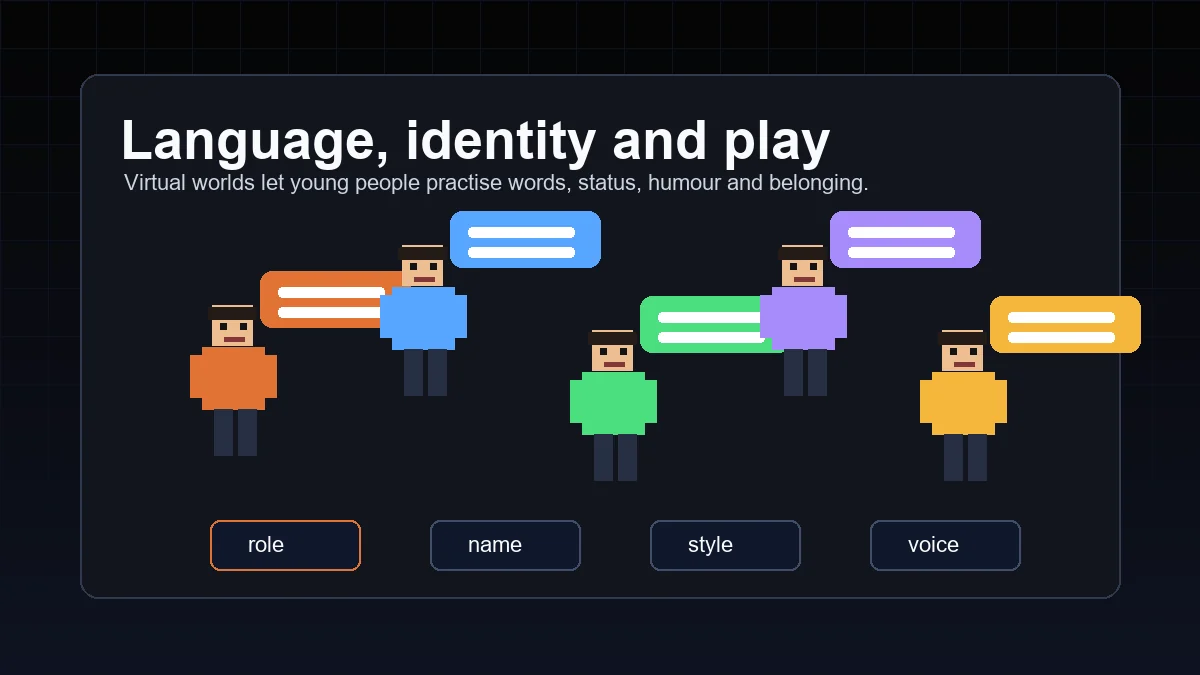
Slang, avatars and room culture helped users learn how online identity works.
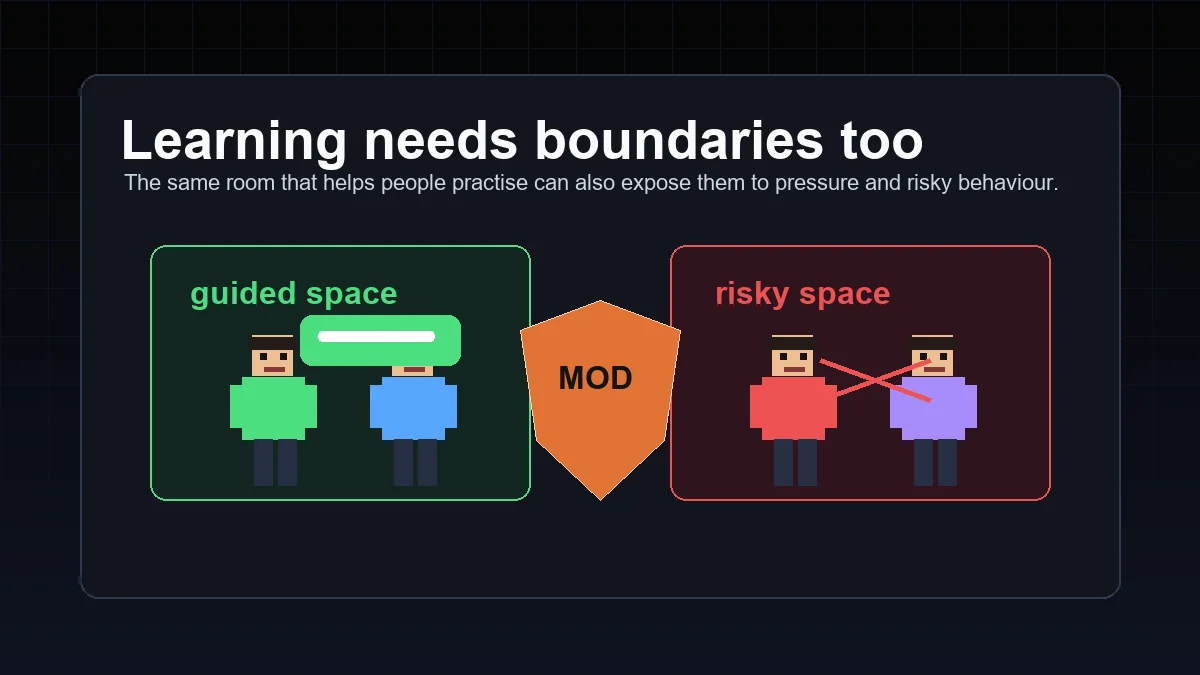
Exploration needs boundaries. That was true in early chat rooms and it is still true now.
Risk and taboo
The point is not that every risky topic is good. It is that children were learning boundaries.
The researchers observed children testing age-appropriate risky or taboo subjects: crushes, flirting, family tension and occasional mild swearing. Rather than treating every awkward exchange as proof the internet should be unplugged, the study frames some of this as developmental boundary work.
Users also corrected one another. When behaviour felt creepy or pushed too far, peers ignored, challenged or socially sanctioned the user. It was messy, but it showed community standards forming in real time.
A room without boundaries becomes chaos. A room with only restrictions teaches obedience, not judgement. The interesting bit is the space between.
What informal learning looks like
It was exploratory, collaborative, reflective and cultural
Exploratory
Children clicked, typed, failed, tried again and learned what the system allowed.
Collaborative
Knowledge spread horizontally through tips, imitation and shared activities.
Reflective
Users discussed what worked, why something failed, and what was fair.
Cultural
Slang, humour, fashion and etiquette became part of knowing how to belong.
Classroom lessons
What schools and designers can learn from it
The study highlights a gap between formal classroom teaching and the peer-driven learning children were already doing online. Schools tended to assess and control. Online spaces often let users explore, copy, teach and reflect.
Use peer tutoring rotations so experienced students help newcomers.
Create sandbox projects where mistakes are low-cost and exploration is allowed.
Add micro-prompts and visible cues that guide discovery without killing it.
Use short reflection sessions so practice turns into actual knowledge.
The teacher does not vanish. The role changes: less “I know everything”, more “I designed a space where learning can actually happen”.
Modern platforms
Habbo’s learning patterns did not disappear. They moved to Discord, Roblox and Minecraft.
The platforms are different now, but the pattern is familiar. Newcomers learn from veteran users, interface design shapes behaviour, and communities invent their own rules. Older chat software rose and fell too, which is why our 123 Flash Chat is gone article matters when looking at how chat platforms age.
Peer learning dominates
A building trick, bot command or server habit can spread faster through users than through official instructions.
Design shapes behaviour
Visible buttons, prompts, roles and rewards quietly teach people what the platform values.
Safety needs skills
Teaching judgement, scam awareness and community norms is stronger than only blocking access.
Conclusion
Chat rooms were never just streams of text
The Habbo Hotel study reminds us that chat rooms and virtual worlds can become laboratories for social learning. Young people were practising negotiation, identity, language, risk judgement and shared knowledge.
That does not mean every online space is beneficial. Context, supervision, design and moderation matter. But the core lesson is still strong: systems and communities teach together.
The best online spaces are not the ones where nothing can happen. They are the ones where people can explore, get help, make mistakes, learn the room and not be left to figure everything out in the dark.
The History of World of Chat shows why we kept that older room culture alive.
Key citations
Sources used in the original article
Willett, R. and Sefton-Green, J. (2002). Living and learning in chatrooms (or does informal learning have anything to teach us?). Education et Societes, 2, 57-77.
Buckingham, D., Sefton-Green, J. and Willett, R. (2003). Shared Spaces: Informal Learning and Digital Cultures. London: Institute of Education.
Buckingham, D. (ed.) (2007). Youth, Identity, and Digital Media. MIT Press.
Sefton-Green, J. (2004). Literature Review in Informal Learning with Technology Outside School. NESTA Futurelab.
Chat rooms still teach people how rooms work.
The trick is building spaces where people learn conversation, boundaries and confidence, not just how quickly a room can become a mess.