
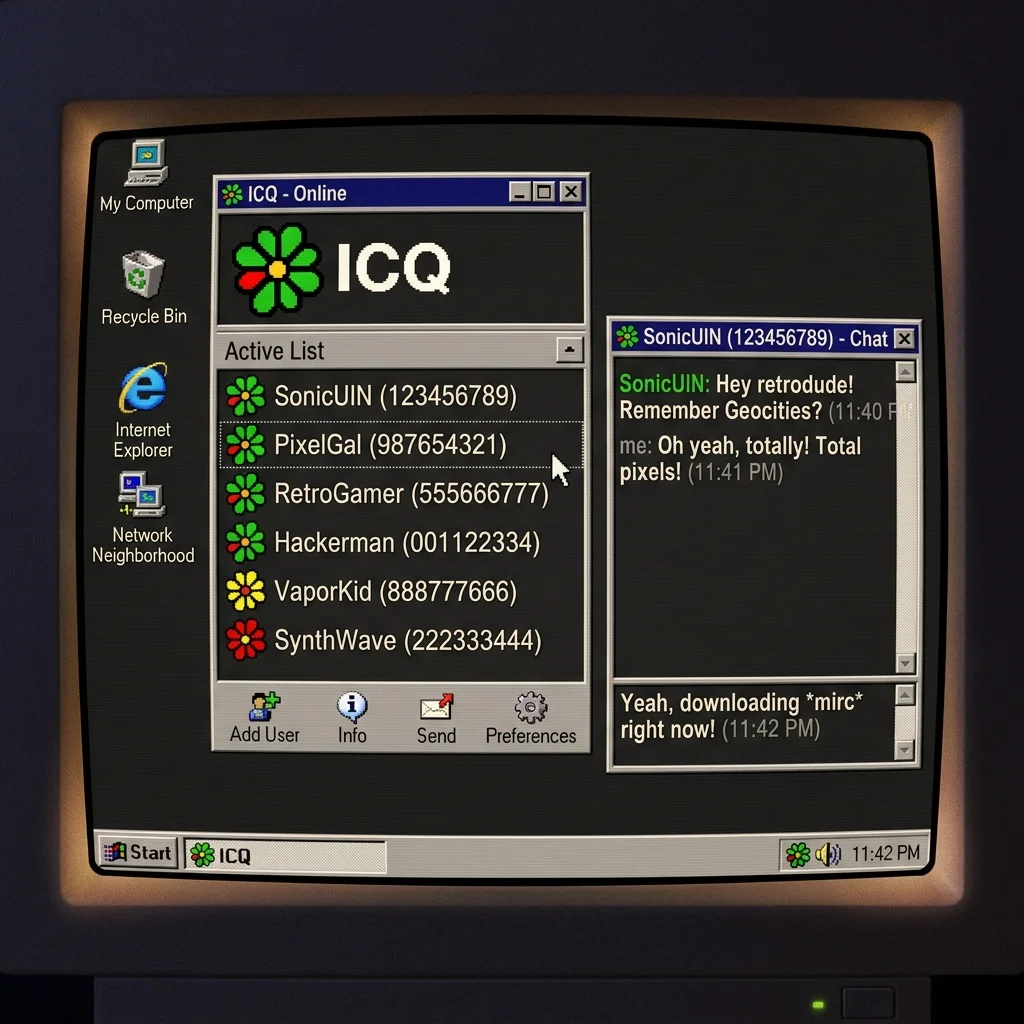
Old messenger autopsy
ICQ is Dead (For Real This Time): Pagers, Hackers, and the Legend of the Uh-Oh Chime
If you went online in the late nineties, your computer did not just boot up; it struggled. You pressed the power button, went to boil the kettle, made a piece of toast, and by the time you got back, Windows 95 was still grinding its teeth trying to load a tiny green flower icon in the bottom-right corner of your screen.
That flower was ICQ. And as of June 26, 2024, after twenty-eight years of lingering in the background like a guest who does not realize the party ended in 2004, the servers have finally been switched off.

A tribute to the green flower era: lost UINs, noisy alerts, suspicious file transfers and the kind of nostalgia that smells faintly of warm dust.
What happened?
A tiny green flower, a lost number, and the end of a very noisy era.
ICQ was messy, brilliant and very much of its time. That is exactly why people remember it.
I actually tried reinstalling it once, probably around 2010, thinking I would take a cheeky trip down memory lane. I could not remember my old UIN to save my life, which was a proper shame. I would have loved to dig up my old chat logs and laugh at how innocent and sweet my teenage conversations were compared to the bin-fire of the modern web.
Instead, what I found was a digital wasteland. There was not a single real person from the UK online. The buddy list was just a wall of automated spambots with links to dodgy porn sites in their profiles. I logged straight back off, thoroughly disappointed.
Which begs the obvious question: who the hell was still using it by the end? What kind of absolute animal was still loading up ICQ in the 2020s?
For those of us who were there at the beginning, though, it is a strange sort of grief. ICQ was not just a chat app; it was the first time we realized we could talk to people on the other side of the planet without our parents getting a seventy-pound BT phone bill.
Here is a look back at why it was brilliant, why it was terrible, and why we will miss it.
ICQ memory 01
The Ultimate Tech Flex: The UIN (Unified Identification Number)
Before the web got boring and everyone logged in with their real names or Google accounts, ICQ handed you a UIN, a Unified Identification Number. It was a completely random five-to-nine-digit number that acted as your entire online passport, and you had to memorize it.
Sign up with your email? What the hell was an email back in 1996? Nobody had an email address. The only people emailing each other back then were university professors in corduroy trousers or NASA scientists. The rest of us did not even know what the @ symbol was actually for until Hotmail turned up a few years later.
ICQ UIN: 4859201
Memorizing your UIN was a rite of passage. If you fancied someone at school, you did not ask for their mobile number. No one had mobiles except businessmen and drug dealers. You asked for their ICQ number.
And then there was the pager integration. In 1999, if you had an ICQ number linked to a physical pager clipped to your belt, you were not just a teenager sitting in a drafty box room in Birmingham. You were basically Captain Picard.
ICQ memory 02
The Sound of Jumpscares: The “Uh-Oh!”
Modern messaging apps are silent. They give you a polite little haptic buzz or a gentle ping. ICQ, on the other hand, had the sound design of a construction site.
Whenever you received a message, your speakers blasted out a screeching, high-pitched “Uh-oh!” that sounded like a cartoon baby realizing it had just dropped a plate.
Combined with the typewriter clatter that played as characters appeared, logging onto ICQ was a noisy, industrial affair. It let the entire house know you were trying to be social.
ICQ memory 03
The Wild West of Hacking (and Extreme Slowness)
Let us be honest: in the early days, ICQ was slow. If someone tried to send you a 3MB MP3 file, you had to plan your evening around it.
But the slow speed did not stop it from becoming a massive playground for script kiddies and amateur hackers.
Because security in the late nineties was practically non-existent, ICQ was the Wild West. You spent half your time chatting about game cheats, and the other half dodging suspicious file transfers from random users.
Every teenager with a dial-up connection thought they were in The Matrix because they had downloaded a trojan program like SubSeven and were trying to make their mate’s CD-ROM drive open and close remotely.
It was chaotic, slightly sketchy, and absolutely brilliant. Which is basically the late-nineties internet carved into a sentence.
ICQ memory 04
The Death by a Thousand Ads
So why did we leave?
AOL bought ICQ, and like everything AOL touched back then, they bloated it. By the early 2000s, the clean, taskbar-dwelling software we loved had turned into a monster.
It was stuffed with banner ads, flash animations, search bars, games and useless features that hammered your RAM.
When MSN Messenger arrived, it was fast, sleek and did not look like an advertising billboard had thrown up on your desktop. We migrated, leaving our UINs behind to gather digital dust.
That was the real killer. ICQ did not suddenly become useless; it became heavy. The thing that once felt like a quick little window into the internet started feeling like a desktop shopping centre with a chat box stapled to the side.
Then the web moved again. Messenger apps, social networks and phones took over the everyday chat habit. ICQ carried on in the background for years, but for most old users it had already become a memory long before the official shutdown.
More closed chat history
ICQ is not the only old chat name buried in the internet attic.
If you enjoy remembering the platforms that shaped online chat before quietly vanishing, the Chat Room Graveyard collects closed messengers, dead chat rooms, old widgets and software that either shut down, faded away, or now exists mostly as screenshots and arguments in comment sections.
The old messengers are gone. The itch to chat is not.
ICQ belongs to internet history now, along with lost UINs, noisy alerts and buddy lists full of ghosts. World of Chat is not trying to rebuild 1998 pixel by pixel; it is trying to keep the best part alive: dropping into a room, finding real people, and having a conversation that is not controlled by an algorithm wearing a cheap suit.