

63-country PISA study
How chatting quietly trained us to skim instead of read
A decade of data suggests that reading more does not always make you better at reading. If most of that reading is fast, fragmented chat, your brain may get very good at scanning and very bored by depth.
We read constantly: notifications, DMs, group chats and endless feeds of text. Logically, we should be the strongest readers in history. The awkward bit is that the data points the other way. The history of World of Chat is part of that older text-first web culture.
-25pts
Reading score drop
+39%
Chat usage rise
Zero
Maths effect
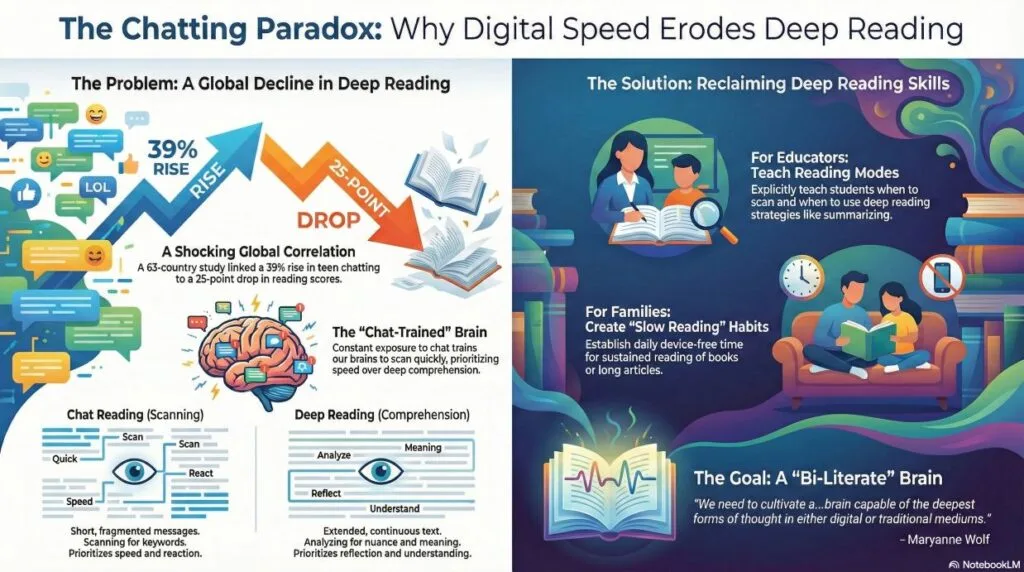
How fast digital reading can crowd out slower, deeper comprehension.
The problem
The more teenagers chatted online, the worse reading comprehension became
In 2021, researcher Hans Luyten published findings in Studies in Educational Evaluation using PISA tests across 63 countries. The uncomfortable pattern was simple: countries with rapid growth in teen online chatting saw reading scores fall.
The strange part is that maths and science scores were barely affected. This was not a general collapse in intelligence. It looked much more like a targeted hit to reading comprehension.
The global explosion of online chatting explains almost all of the worldwide decline in reading literacy between 2009 and 2018.
The paradox
Why more reading can make you worse at reading
At first glance this sounds ridiculous. Surely reading thousands of messages a day should make people better readers. That would be lovely. Sadly, brains enjoy making everything more complicated than a kettle instruction leaflet.
The trap is not simply how much we read. It is how we read. Chat trains the brain for speed, interruption and instant reply. Deep reading needs patience, context and the ability to hold an idea for longer than three furious seconds.
Chat reading
The skim brain
Fragmented bursts of text with very little context.
Rapid exchanges demanding instant replies.
Constant interruptions breaking focus.
Keyword scanning instead of sentence digestion.
Language shortened into emojis, abbreviations and reaction bait.
Deep reading
The focus brain
Extended text requiring sustained attention.
Building mental models paragraph by paragraph.
Understanding nuance, tone and subtext.
Holding conflicting ideas without immediately exploding.
Reflection without needing a notification to applaud you.
What changes in the brain?
Fast text rewards fast thinking. That is useful, until it becomes the only gear
Nicholas Carr warned that digital interfaces encourage surface reading. Maryanne Wolf’s work goes further, explaining the biological mechanism: neuroplasticity.
When most text arrives as short, fast and fragmented bursts, the brain prioritises speed over depth. Then a long email, contract, book chapter or serious article starts to feel weirdly painful. Not because you are stupid. Because the machine has been training you badly.
The digital culture’s reinforcement of rapid attentional shifts can short-circuit the slower comprehension processes involved in deep reading.

Fast chat trains one kind of attention. Deep reading asks for another.
Text-trained brain vs reality
The study split countries into two different stories
The biggest damage appeared where chat use exploded quickly. Where countries had already reached high chat saturation by 2009, the later trend was slower and in some places stabilised.
Group 1
Late adopters
Japan, South Korea, Indonesia and Brazil saw rapid chat adoption after 2009, then reading scores fell sharply.
Group 2
Early adopters
The US, Canada, Australia and much of Europe already had high chat saturation, so the later shock was smaller.
63
Countries
The pattern was drawn from a broad international dataset, not a tiny survey with a heroic clipboard.
2009-18
Study window
A long enough period to see what happened as online chat became normal teenage infrastructure.
Recovery
How to hack your brain back
This is not a doomsday prediction, and nobody needs to throw their phone in a river. The useful bit about neuroplasticity is that it works in both directions.
You can train a bi-literate brain: one that can skim quickly when needed, but still slow down and read properly when the text actually matters. If you do want quick conversation, choose a safer random chat option and keep it as one mode, not your whole reading diet.
Force the switch
Teach the difference between skim mode and deep mode so people know which gear they are using.
Balance the diet
Blend digital research with long-form print or screen reading that demands unbroken concentration.
Model the behaviour
If children only see adults reading tiny updates, they learn the same fractured attention pattern.
Make it boring on purpose
Twenty quiet minutes with one text is not glamorous. That is exactly why it works.
20-minute challenge
A cleaner version of the old interactive widget
The original page asked users to click each step to track progress. This keeps the idea, but turns it into a clean, lightweight checklist that will not need extra JavaScript to make the page behave.
1
Pick one text
Book, article, essay or long guide. One thing. Not seventeen tabs pretending to be research.
2
Mute the noise
Put the phone away or silence notifications. Your group chat can survive without your wisdom for twenty minutes.
3
Read slowly
No skimming, no bouncing around, no pretending the intro counts as the whole thing.
4
Summarise it
Write three sentences about what you actually understood. Brutal, useful, slightly annoying.
Conclusion
Chat made the world talk more. It did not always make us understand more
Online chatting made communication faster, easier and more constant. That is not automatically bad. The problem begins when chat becomes the main way young people experience text, which connects to the wider question of whether chat rooms make us more honest or just more lonely.
The future belongs to people who can do both: move through digital noise quickly, then slow down, disconnect and actually read when the subject deserves more than a glance. That is the balance behind the text-first chat rooms on World of Chat: conversation is useful, but it should not replace every slower kind of reading.
Sources and further reading
The references worth keeping
Luyten, H. (2021).
Wolf, M. (2018).
Carr, N. (2010).
OECD (2019).
Baron, N. S. (2021).
Liu, Z. (2005).
Mangen, A., et al. (2013).
Ward, A. F., et al. (2017).
Use chat. Just do not let it become your only reading muscle.
World of Chat is built for conversation, but even we can admit that sometimes the healthiest thing online is logging off for twenty minutes and reading something that fights back.