
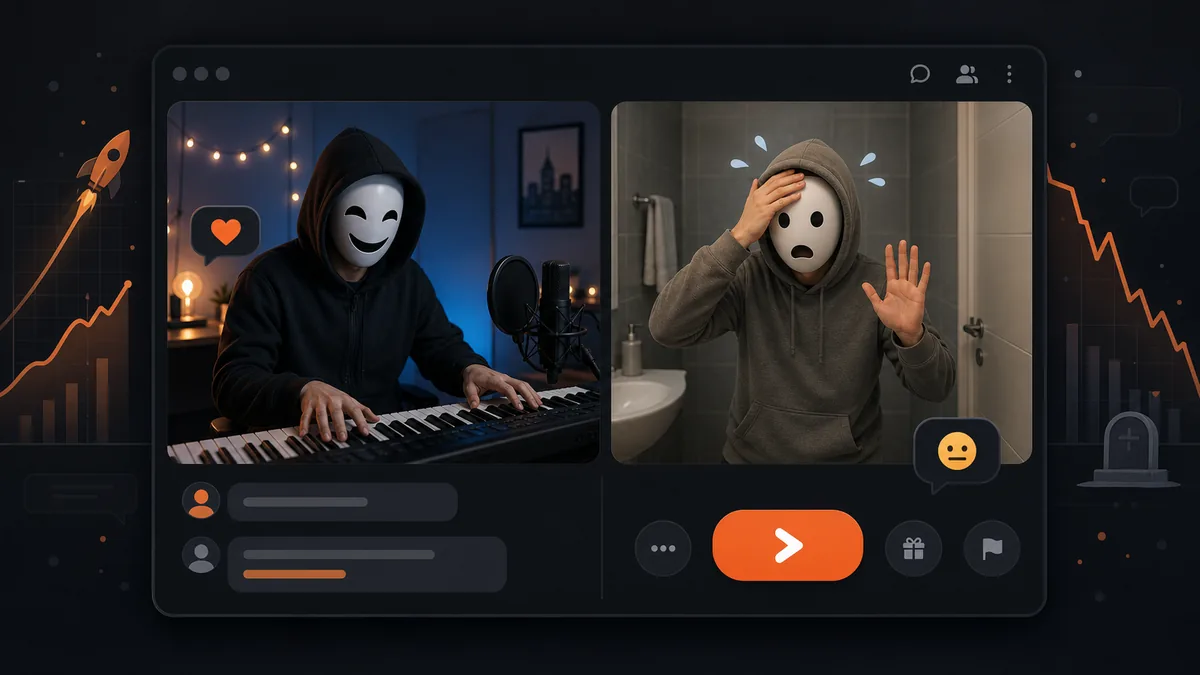
Safe moderated chat – no registration
From a viral sensation to a digital ghost town, Chatroulette changed how people thought about random connection online. It also became the internet’s very loud reminder that anonymity without moderation can go spectacularly sideways.
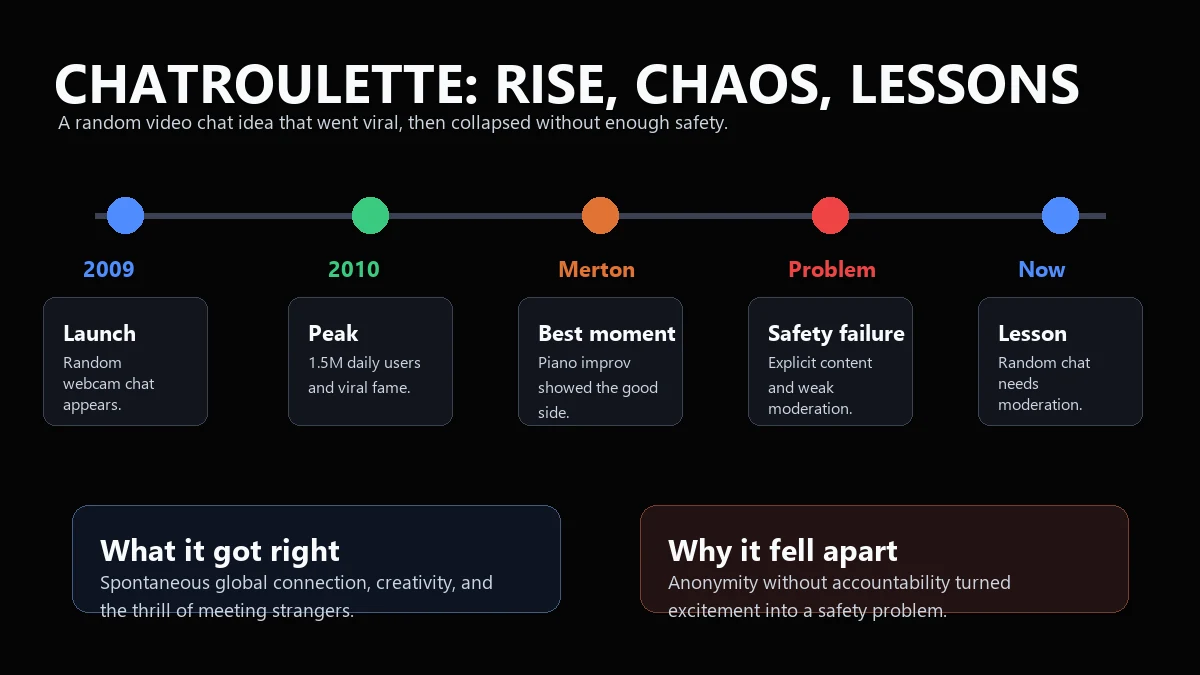
The short version: global webcam magic, piano man joy, then a safety bin fire with a Next button.
Site Safety Scorer
Check the moderation, privacy, and safety risks of popular chat sites.
Analyzing moderation logs & safety reports…
—/10
Platform Name
🛑 Extreme Risk PriorityCritical Safety Issues Found:
SAFE ALTERNATIVE: World of Chat
10/10 Safety Score • Actively Moderated • No Bots • UK-Based
Chat Safely Now 🔒Before the collapse
For a moment, random video chat felt genuinely new.
Before TikTok transformed live streaming into a global phenomenon, before Omegle became a household name, and before talking to strangers through your webcam felt normal, there was Chatroulette.
Chatroulette exploded onto the scene in 2009. A Russian teenager created it in his bedroom. Within months, millions of people worldwide were clicking the Next button, hoping to meet someone interesting on the other side of their camera.
The concept was beautifully simple. You opened your browser, allowed webcam access, and were instantly connected to a complete stranger somewhere in the world. If you did not like what you saw, you clicked Next and moved on.
No algorithms decided who you met. No profiles filtered your options. Just pure, unfiltered human connection through video chat. That rawness was exciting, but it also carried the seed of the problem.
The magic bit
When Merton sat at the piano and made the internet smile.
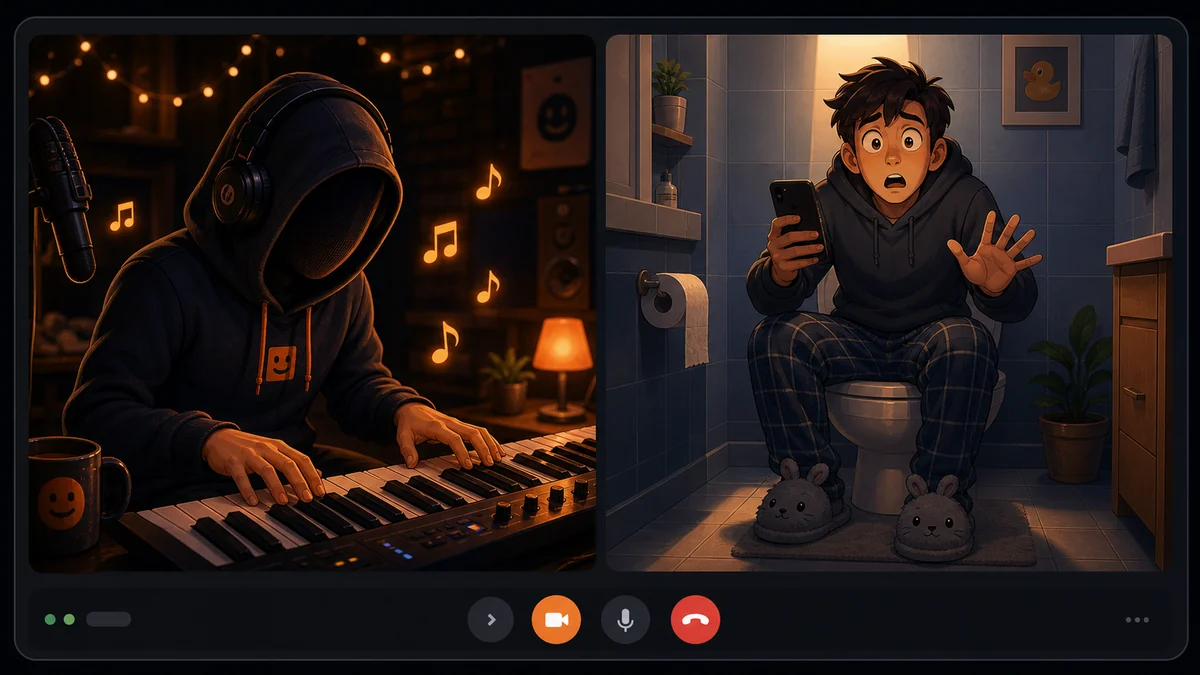
Chatroulette in one image: one side could be musical genius, the other could be someone making deeply questionable webcam decisions.
A mysterious piano player using the name Merton showed what Chatroulette could become at its absolute best. He improvised songs about the random people he met on the platform, turning awkward webcam encounters into spontaneous musical comedy.
The reactions were priceless. Strangers went from confused to delighted in seconds. They laughed, applauded, sang along, or sat in stunned amazement. These were not scripted moments. They were authentic human responses to unexpected creativity pouring through a webcam.
What made Merton special
Genuine musical talent, kindness, improvisation, and proof that random video chat could be wholesome when people used it well.
The cultural impact
Millions of views, mainstream media coverage, imitators, tributes, and one of the defining positive moments in Chatroulette history.
The problem nobody could ignore
The same randomness that made it exciting also made it unsafe.
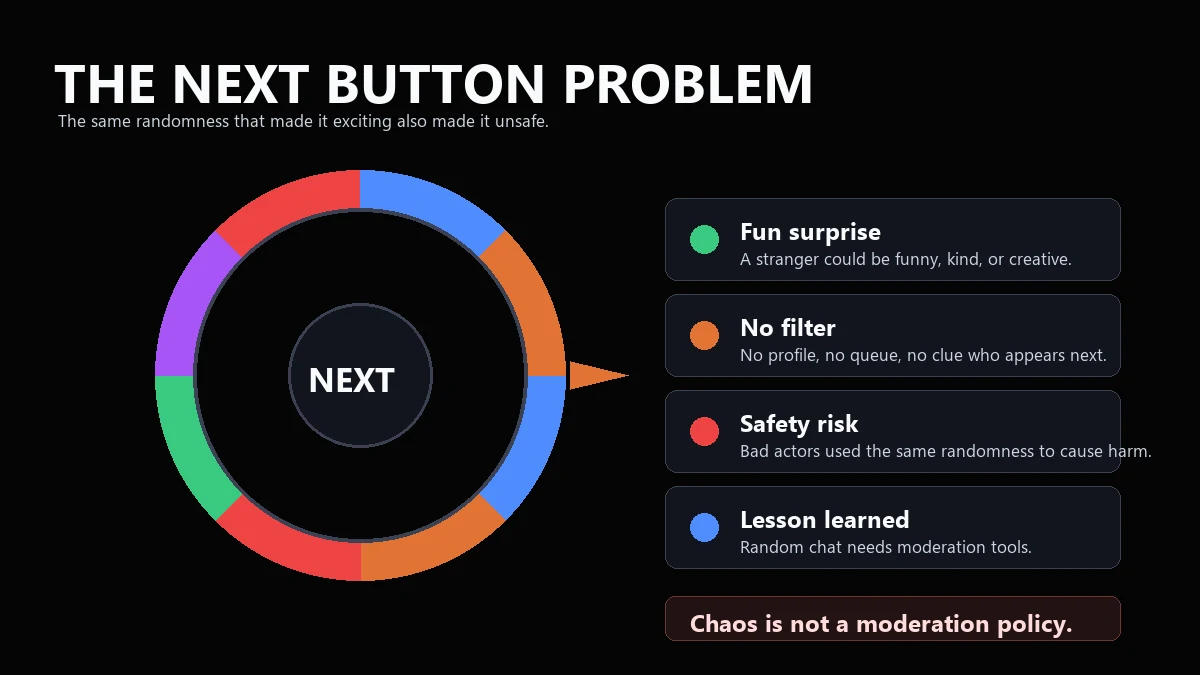
The Next button was the feature, the escape hatch, and eventually the whole user experience. Not ideal.
The magic did not last long. Complete anonymity with zero accountability created an environment where inappropriate behaviour flourished. Explicit content became increasingly common, and what started as occasional shock encounters became the dominant experience for many users.
People stopped using Chatroulette for genuine connection. They kept their finger hovering over the Next button, clicking away at any sign of trouble. Women and younger users abandoned the platform first, and the user base skewed heavily in the wrong direction.
Safety concern: by mid-2010, studies estimated that nearly 15% of Chatroulette connections involved inappropriate explicit content. That reputation was almost impossible to recover from.
Key failure points
No effective moderation, weak reporting, easy ban evasion, viral growth outpacing safety infrastructure, and total loss of public trust.
What modern platforms learned
AI moderation, instant reporting, stronger bans, human moderators, and safer matching all exist because platforms learned from this exact mess.
What it got right
Chatroulette was not a bad idea. It was an under-moderated idea.
Despite its downfall, Chatroulette deserves credit for genuine innovation. It proved that strangers wanted spontaneous connection and that geography no longer limited social interaction.
The platform showed both the best and worst of anonymity. The Merton moments proved people could be creative, kind, and generous. The collapse proved they could also be destructive without accountability.
Its influence on later platforms cannot be understated. Random video chat, live streaming culture, video rooms, instant stranger matching, and moderation debates all carry some trace of what Chatroulette made visible.
Can random video chat work?
Yes, but only when spontaneity has guardrails.
The moderation problem remains central to any random video chat platform. Complete anonymity encourages bad behaviour, but heavy identity checks kill spontaneity. Modern platforms try to find a middle ground. If you want a text-chat comparison, our Chatiw report explains how to avoid problems in chat rooms before trusting anonymous spaces too quickly.
AI moderation today is far more sophisticated than in 2010. Machine learning can detect inappropriate content in real time, while human moderators review reports and enforce consequences. Geographic and age-based matching can also reduce problems. For another old chat platform with similar risk questions, our Chatib safety review is worth reading before trusting anonymous rooms too quickly.
Was Chatroulette simply ahead of its time? Perhaps. The core concept was not flawed. The lack of safety infrastructure made it unsustainable. Chat Avenue shows another old-web approach to live rooms, but the lesson is similar: the dream did not die; it evolved into safer platforms.
Common questions
Chatroulette FAQ
What happened to Chatroulette?
It still exists, but with a fraction of its original user base after reputation damage from its unmoderated past.
Why was it controversial?
Widespread explicit content, lack of moderation, child safety concerns, and little accountability made it a mainstream warning story.
Who was Merton?
An anonymous piano player who improvised songs for strangers and showed the wholesome creative potential of random video chat.
Are there safer alternatives?
Yes. Modern random chat platforms use better moderation, reporting, matching, and safety controls than early Chatroulette had.
Random chat did not die. It grew up a bit.
The best parts of Chatroulette were real: surprise, creativity, and connection. The lesson is simple: keep the magic, add moderation, and stop pretending chaos is a feature.