
Simple guide to online chat
Ever wondered how people connected online before Facebook and Instagram took over? Chat rooms were the original social networks. They remain popular today for people seeking real conversations without the pressure of perfect profiles or endless scrolling.
This guide explains what chat rooms are in simple terms. You’ll learn how they work, who uses them, and whether they’re still worth your time today.
A chat room is basically a live room full of keyboards, minus the follower counts and holiday-photo performance review.
The short version
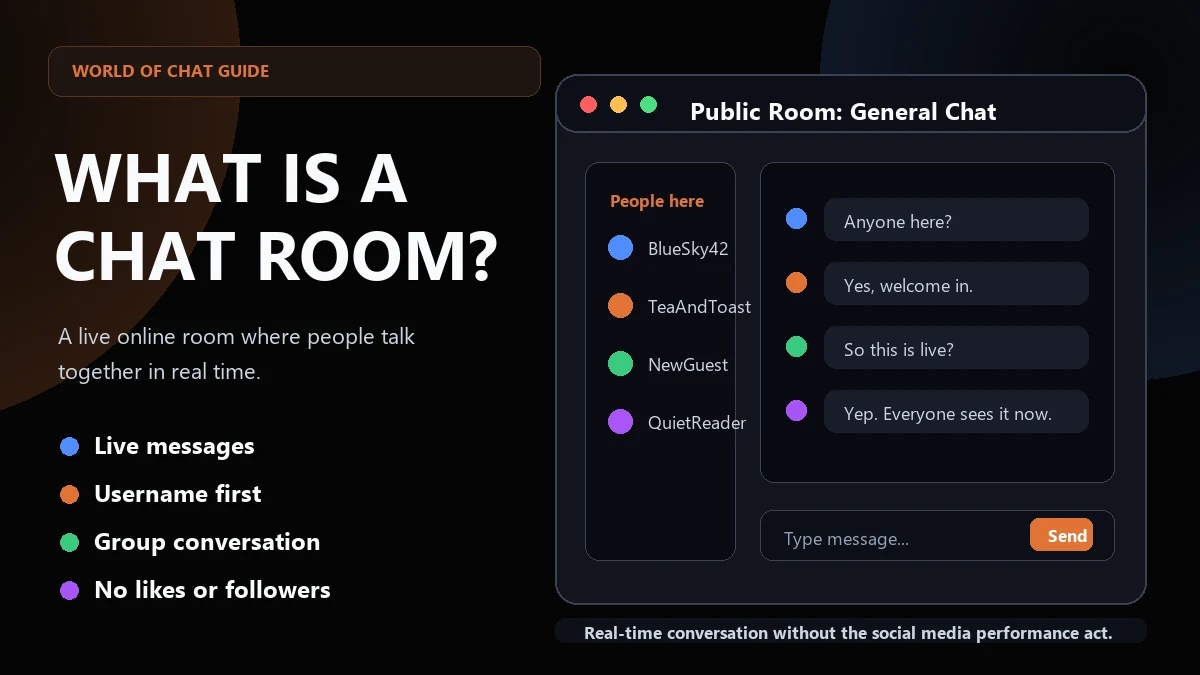
A chat room is a live digital room where people talk in real time.
A chat room is a digital space where people talk to each other in real time using text messages. Think of it as a virtual room where multiple people can have conversations simultaneously.
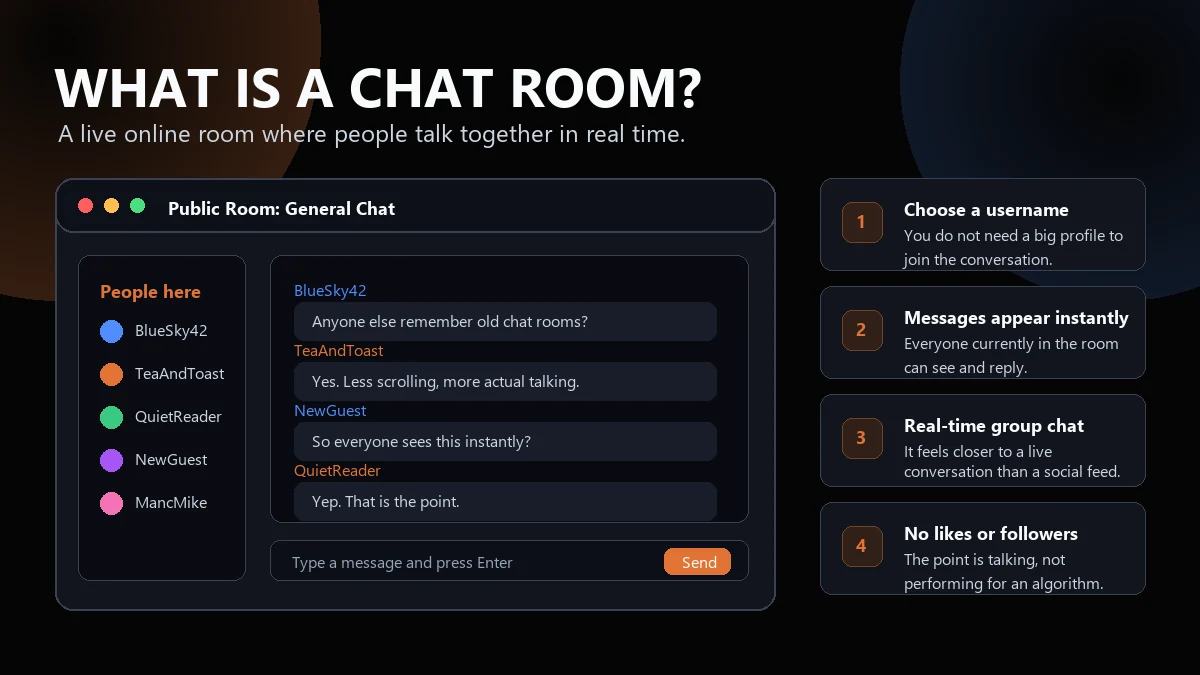
The key difference from social media is immediacy. When you type a message in a chat room, everyone currently in that room sees it instantly. There is no algorithm deciding who sees what. No likes or followers. Just real people having real conversations as they happen.
Most chat rooms let you choose a username without revealing your real identity. You can join conversations, ask questions, share opinions, or simply read what others are saying.
The beauty of chat rooms lies in their simplicity. You do not need to build a profile, collect friends, or worry about your post history. You just show up, chat, and leave when you are done.
A quick history
From university terminals to ordinary people logging on after tea.
Chat rooms started in the 1970s with basic computer networks. Early systems like Talkomatic let university researchers exchange messages in real time. These primitive chat rooms could only handle a few people at once.
The 1990s brought chat rooms to ordinary people. Services like AOL Instant Messenger and Yahoo Chat became wildly popular. Millions logged on each evening to meet strangers and make friends. Chat rooms were often the highlight of being online. Later software came and went too; our 123 Flash Chat is gone article explains one of those older platform collapses.
Social media platforms like Facebook arrived in the mid-2000s and changed everything. People shifted toward profiles, photos, and permanent posts. Many predicted chat rooms would disappear entirely.
Yet chat rooms survived and evolved. People seeking anonymous support, niche interests, or real-time conversation still prefer chat rooms over social media. Modern platforms have expanded beyond text too, with webcam and voice rooms adding extra ways to read the room.
How they work
No degree required. Pick a room, choose a name, start typing.
Understanding how chat rooms function does not require technical knowledge. Most chat rooms work through your web browser. You visit a website, choose a room that interests you, and pick a username. Some sites require registration, while others let you start chatting immediately.
01
Joining a room
Free chat rooms typically do not ask for payment or personal details. You simply choose your display name and enter the room.
02
Sending messages
Messages appear in chronological order. Type at the bottom, press enter, and your words appear instantly for everyone in the room.
03
Features and tools
Modern rooms may include private messaging, voice chat, video, file sharing, or moderation tools that help keep the room usable.
Active rooms can move quickly with dozens of people talking at once. Quieter rooms let you follow conversations more easily. You control how much or how little you participate.
Types of chat rooms
Some rooms are a general natter. Some are basically a club with a keyboard.
A
General chat rooms
General rooms welcome any topic. People discuss current events, share stories, make small talk, or simply observe before joining in.
B
Topic-based rooms
Gaming, dating, regional, support, hobby, language and community rooms help people find others with shared interests quickly.
C
Public vs private rooms
Public rooms allow anyone to join. Private rooms use invitations or passwords and are better for smaller, controlled group conversations.
The choice between public and private depends on what you seek. Public rooms offer excitement and variety. Private rooms provide intimacy and control over who participates.
Who uses them and why
Lonely people, hobby people, curious people, and people dodging another social feed.
Chat rooms attract people from all backgrounds and age groups. Their users often share common needs that traditional social media does not always fulfil.
Many people turn to chat rooms when feeling isolated or lonely. The ability to connect with others instantly provides comfort, and you do not need existing friends or followers to start a conversation. That is why the question of whether chat rooms make us more honest or just more lonely is worth asking.
Enthusiasts use chat rooms to discuss their passions in depth, from vintage cars and knitting to gaming and science fiction. Niche rooms connect people who share interests that friends and family might not understand.
Chat rooms also help people meet new friends who would never cross paths otherwise. Geography does not limit who you can meet, and repeated conversations can become genuine long-term connections.
Safety first
Chat rooms can be useful, but strangers are still strangers.
Safety in chat rooms requires awareness and sensible precautions. Strangers might not be who they claim to be. Some users lie about age, gender, or intentions. Scammers may try to extract money or personal information through friendship or romance scams.
Inappropriate content can appear in unmoderated rooms, including explicit language, harassment, or attempts to share illegal material. Privacy breaches can also happen if you share too much personal information.
1
Protect your identity
Never share your full name, address, workplace, school, passwords, payment details, or contact information in a public chat room.
2
Trust your instincts
If someone makes you uncomfortable or pressures you for information, leave the conversation and block them.
3
Choose moderated rooms
Active moderators remove disruptive users and enforce rules, creating safer environments for genuine conversation.
Safety first: legitimate chat rooms never ask for payment details, passwords, or sensitive personal information. Be especially cautious of anyone pushing you onto less secure platforms.
Social media asks you to polish the performance. Chat rooms ask what you are actually saying.
Chat rooms vs social media
Both connect people, but the vibe is completely different.
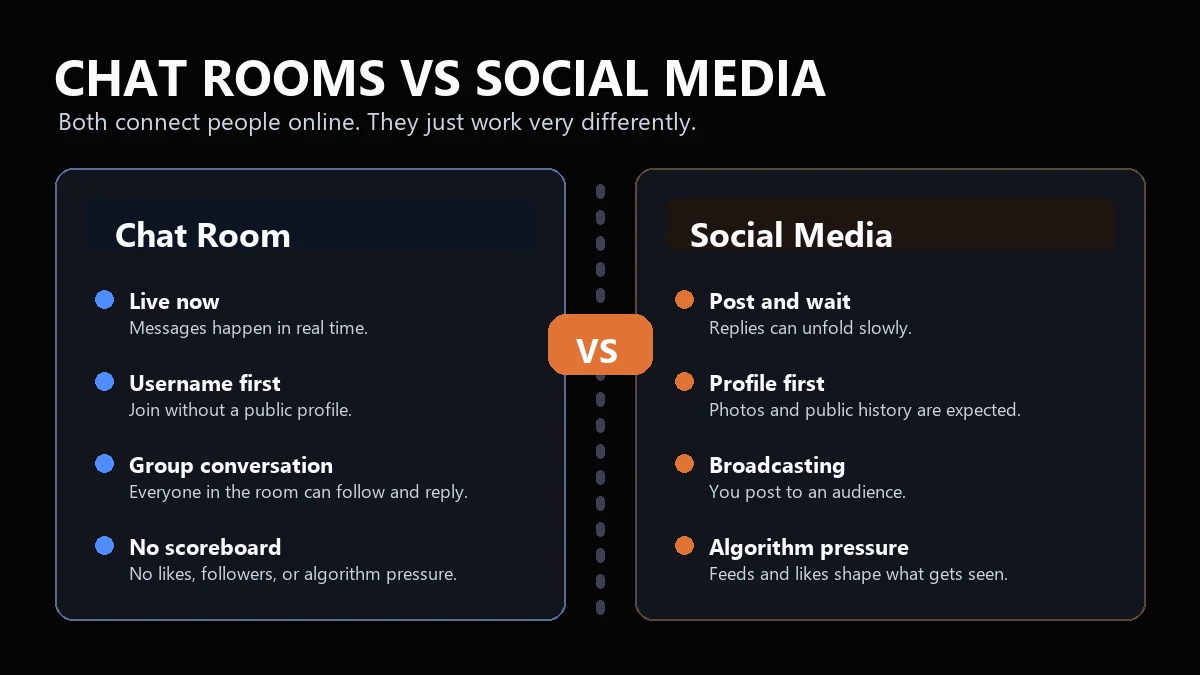
Chat rooms typically allow anonymity. You control what you reveal about yourself. Social media encourages real identities, photos, detailed profiles, and a permanent record. Anonymity can help people open up, but what went wrong with Omegle shows why it still needs boundaries.
Chat room conversations happen in real time with immediate back-and-forth exchanges. Social media relies on posts and comments that unfold over hours or days.
Social media emphasizes visual content, personal updates, and broadcasting to followers. Chat rooms focus on conversation and connection, with no news feed algorithm deciding what you see.
Why some people prefer chat rooms
No likes, shares, follower counts, or competitive pressure. You participate for conversation itself, not social validation.
Why social media feels different
Social platforms often reward performance, permanence and broadcasting. That is useful for some things, exhausting for others.
Finding your community
The right room makes all the difference.
Chat rooms serve diverse communities with specific needs and interests. Cultural and identity-based rooms provide spaces where people share heritage, language, or experiences. Black chat rooms, for example, create spaces where cultural context is understood without explanation.
Language learners use chat rooms to practise with native speakers in real-time conversation. Support and mental health rooms can provide crucial connection for people facing difficult challenges, especially when anonymity helps people speak honestly.
The best chat room is not always the busiest one. It is the one where the topic, moderation, pace and people fit what you actually need.
Conclusion
Chat rooms still do something social media forgot how to do.
Chat rooms remain valuable spaces for genuine human connection in our digital age. They offer real-time conversation without performance pressure, anonymity when you need it, and communities built around shared interests rather than follower counts.
From their origins in the 1970s to modern platforms with voice and video capabilities, chat rooms have evolved while maintaining their core appeal. They connect lonely people, unite enthusiasts, support struggling individuals, and introduce friends who might never otherwise meet.
Safety requires awareness, but sensible precautions make chat rooms as safe as any online space. Choose moderated rooms, protect your privacy, and trust your instincts about people and situations.
Are chat rooms still worth using today? Absolutely. For anyone seeking authentic conversation, anonymous support, or communities that understand their interests, chat rooms offer something social media simply cannot replicate.
Explore chat room communities
A few useful directions once you understand the basics.
Now that you understand what chat rooms are and how they work, you might want to explore specific communities that match your interests.
Support communities
Depression and anxiety chat rooms can help people find understanding and connection.
Regional connections
Newcastle and Bradford chat rooms help people connect with others from local areas.
Cultural communities
Black chat rooms create space for community conversations online.
Language and learning
English chat rooms can help people practise communication through real conversation.
Ready to see one in action?
Chat rooms make more sense when you know where they came from. World of Chat has its own long, strange history in the old web tradition.